On The Role Of The Modern Day Pastor

On The Role Of The Modern Day Pastor

When you elevate a job, profession, or role to a position of authority, disconnecting it and compartmentalizing it from the character and obedience of the person performing that job, profession, or role, then you are extrapolating the office from it’s officer. This is witchcraft and superstition: as if your mere words or rites or incantations or rituals or formalities have any real power to make changes in your life or serve you in any viable way.

Such incantations demand that a title of a man justifies the man, and not vice-versa. As if the power, glory, and pleasure of God can be fulfilled and controlled through divination by ascribing the right words (“pastor“, “elder“, “shepherd“…) to a man in a collar, or by association in fulfilling the right exercises (“baptism“, “tithing“, “church membership“…), going through the motions of churchian culture, copyrighted by an institutionalist covenant with false gods.
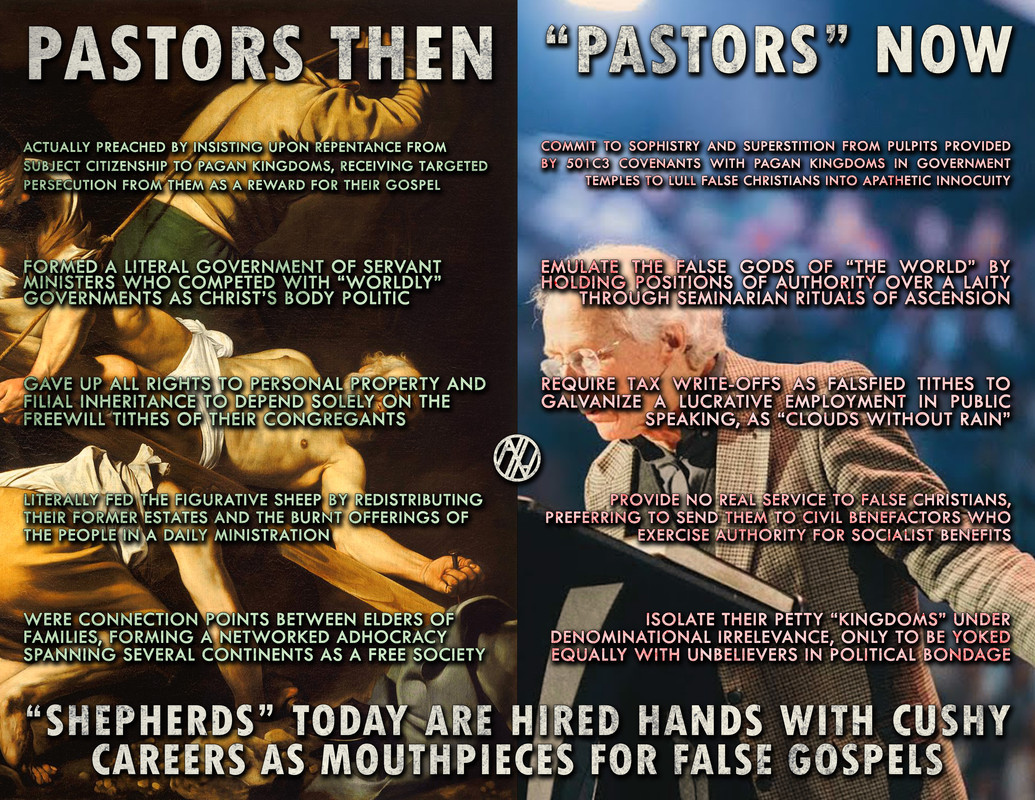
PastorsThenNow

These distractions and busybody, counterfeit caricatures of pious “religion” are not subjected to the jurisdiction of God’s Kingdom. Their magicians and sophists and warlocks do not keep the commands of Christ and reflect the role of Biblical and historical pastors and elders, but rather something less productive than even the Pharisees. And, like the Pharisees, they are not even actually ordained in the Biblical senseand will lead you into the bondage of public religion which provides for them their 501c3 covens and sustains their panhandling pulpits.

“Pastors” aren’t meant to be institutionalists that attend seminaries for formal education, so that they can make a profession out of eisigeting Scripture in order to lead an army of pew-people in ritualistic sing-song, while offering tax-write offs for their tithes in fiat currency. These men do try and model themselves after human civil government though since their 501c3 buildings are incorporated, not under Christ, but the attorney General.

There are men out there who have something to gain by being public “servants”. We call them politicians who receive public funds as a salary, through force by taxation, for doing little to nothing to benefit society. There are also men out there who have something to gain by not serving the people in any way. We call them “pastors” who receive “tithes” and send the people to receive their socialist daily bread from the “Benefactors” who exercise authority. These two groups complement each other and work together in a cartel; with public religion on one side, churchianity on the other side, with sophistry, nationalism, tax write offs and “parachurch” ministry to link them. You can read more about careerism as a convenient substitute for ecclesiastical roles and social virtues here.

OfficesOfPower

And then there are those who have something to lose by serving the people and are doing it anyway. These are the men that threaten the livelihood and comfort and status and worldly tradition of the people in the other two groups.

The shepherds of the first century provided real, selfless service and practiced the pure religion that not only sustained an entire nation of Christians in welfare, education, healthcare and salty-bright holiness, but did so in humility and meekness without any positions of authority. They blazed the trail for an actual and literal Kingdom of God complete with rights, responsibilities, ordinances, government, and prosperity.

Real pastors were the titular government of the people, an order of ministers who owned everything in common, called out from the congregations in order to redistribute their free will offerings to those who had need. This was the Lord’s table that operated in the exact opposite way than the money changer’s tables. Ministers are Benefactors who do not exercise authority, binding the Christian kingdom in faith, hope, and charity as opposed to contract, entitlement, and taxation of the (prime) ministers of the worldly kingdoms.

The far-cry clergy of this century maintain a deceitful version of the Kingdom of God. When professing Christians became slothful and covetous, applying to the false gods of human civil government for validation, protection, provision, and direction, the relationships of those “christians” and the characters of those pastors changed through pagan perversion. Their interpretations of the injunctions of Scripture were perverted in the process, starting a snowball effect regarding dead traditions and human superstitions that culminate in what we have today.

Modern christians have redefined religion to make it about going to a building once a week in order to sing some songs, listen to some sophistry, and eat their crackers and drink their juice. Sometimes they dunk each other in the baptistry. Going through the motions advertised by these cathartic, entertaining rites and rituals of 501c3 untrue and defiled religion will only leave you spiritually, emotionally, and intellectually empty, waiting to be filled by literal destruction contingent upon the inevitable collapse of a society in want of righteous, true Christianity.

Flee the silly, superstitious cult of Churchianity. Its thin veil masks its tether to the unrighteous mammon, and just like every incarnation before it, that mammon will sink like the Titanic, capsized from its own sloth, lethargy, covetousness, and hatred for its neighbor and the God of the early Christians.

Do not be like the lotus-eaters of the modern Lord’s supper, or listen to the siren’s song emanating from the pulpit. They will only confuse you and lead you to your destruction, albeit piously and merrily. Rather, repent and seek ye first the Kingdom of God and His righteousness. Believe on the Gospel of God, so that you may be redeemed from giving men arbitrary authority over your heart, soul, and mind.
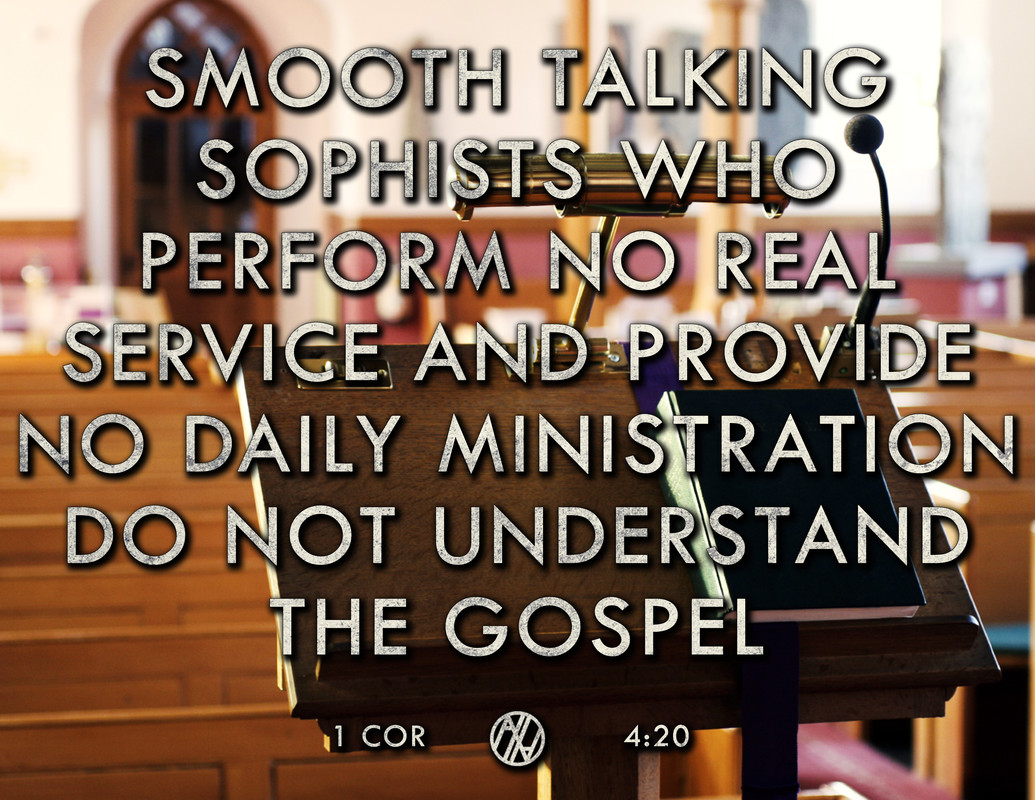
Sophists

Know Nothing Among You: A Testimony

Know Nothing Among You: A Testimony

March 1, 2014 turned out to be the last Ash Wednesday I was to identify myself as a practicing Catholic. After having spent months of actively denying that the Catholic worldview was false and full of pagan teachings and superstition, I eventually determined to forsake my preconceptions and simply resolve myself to follow Christ, and follow him so closely that I would know nothing else.

In my efforts to discover the truth, I learned of, tested, and eventually adopted the ideology of Abolitionism. Its tenets effectively lay out how a professing Christian is to actively love their neighbor as commanded in a bright and salty capacity while being surrounded by a culture that hates God. I am grateful for my relationships with my fellow abolitionists and am always sharpened and edified by them.

When a mainstream part of the Abolitionist movement began focusing their attention and efforts into the legislative rat-race, I threw in my own attention and effort with enthusiasm. However, the more I tried to further and aid those projects and the more I examined those coordinated efforts, the more I realized that my actions and attention reflected a sort of backslide into my pragmatic projects as a Catholic Pro-Lifer. As I wanted to tell myself I was doing these things for purer motives, I could not honestly discern whether these legislative actions were being pursued and carried out for the fanfare and publicity they accrued for the movement, or with the wholehearted intention that they succeed and get codified into human law.

SkateboarderGirl

Driven by my motivation to know nothing but Christ, I allowed myself the necessary pause in order to investigate my convictions and discerning how they related to my relationship with Him. I began to study what it really meant to be “in the world but not of the world” and how to keep my “religion unstained from the world.” My conclusions crushed me in allowing me to see that I had once again failed by being so easily led astray, by passively following the group, going back the same direction I had come. Shortly after making this realization, I encountered quite a few christian “anarchists” through many contacts within the abolitionist movement, and I was led to experiences in understanding Scripture, including various interpretations of “Romans 13“, each more hermeneutic than my previous presupposition. Ultimately, my conclusions led me to grief for how badly I had failed this mission that I set upon.

However, I did not weep for my failure for my journey has made me know more fully the essence of the Gospel, and compelled me to better understand the implications of Christ’s perfect works on the cross. I am not yet completely sanctified unto the characteristics on the right side of the diagram in this article, but praise God that I am no longer completely characterized by the left side. So on this day, my three year anniversary after intentionally beginning to desperately find out the truth of Christianity and pure religion and obedience, I beseech all of you to examine this information and work out your salvation with fear and trembling.

The blog post is taken from this profile post on Facebook.

Abolitionist Anarchist.jpg

The Politics of Christ

The Politics of Christ

“And you, being dead in your sins and the uncircumcision of your flesh, hath he quickened together with him, having forgiven you all trespasses; Blotting out the handwriting of ordinances that was against us, which was contrary to us, and took it out of the way, nailing it to his cross; And having spoiled principalities and powers, he made a shew of them openly, triumphing over them in it.” (Colossians 2:13-15)

Christ had good reason to remain apart from politics of His day, for He came to preach a political reality that is as timeless as it is righteous. The message He preached was certainly about government, but a government He would establish on the earth, that would be an alternative jurisdiction for His followers. Jesus’ message was about the government of God that would come to rule the earth through the obedience of His little flock.

When Christ was on trial for His life, Pontius Pilate, the Roman procurator of Judea, asked Jesus about His political aspirations and the implications of his birthright to the throne. Examine the exchange:

“Therefore Pilate entered again into the Praetorium, and summoned Jesus and said to Him, ‘Are You the King of the Jews?’

Jesus answered, ‘Are you saying this on your own initiative, or did others tell you about Me?’

Pilate answered, ‘I am not a Jew, am I? Your own nation and the chief priests delivered You to me; what have You done?’

Jesus answered, ‘My kingdom is not of this world. If My kingdom were of this world, then My servants would be fighting so that I would not be handed over to the Jews; but as it is, My kingdom is not of this realm.’

Therefore Pilate said to Him, ‘So You are a king?’

Jesus answered, ‘You say correctly that I am a king. For this I have been born, and for this I have come into the world, to testify to the truth. Everyone who is of the truth hears My voice.'”

(John 18:33-37)

Even though Jesus was born to be King of Judea, was recognized as the King of Judea by thousands of people, and even taught ordinances while spreading the Gospel of His Kingdom, He told Pilate that He was not interested in modeling His Kingdom after the pattern that Pilate represented for Rome (and many civil societies before and since). The “world” that Christ very deliberately washed his hands of is translated from the Greek “kosmos” which means “an apt and harmonious arrangement or constitution, order, government“. The arrangement, constitution, order, and government of Christ’s Kingdom is incomparable and incompatible with that of Rome.

In spite of the clear message from Scripture that the Kingdom of God is a real kingdom, with a real government, with its own jurisdictions, laws, and civil society, most of Christendom throughout history has believed and taught the opposite. Some say the Kingdom is merely in the hearts of men and a place to go to after death, while others say that the mission of Christianity is to sanctify the governments of “this world” in an attempt to compel a bad tree to produce good fruit.

Yet the Bible teaches that Christ’s Kingdom will successfully and independently become an alternative sanctuary for those with ears to hear (Matthew 13:31-32) and will displace the very foundations and efficacy of the kingdoms of “this world” (Daniel 2:34), both in fulfillment of blotting out the ordinances of worldly governments. Though Christians live in “the world,” they are not to be of “the world” (John 17:16). Rather, they are to be like the leaven that infects those in the world rather than remain reclusive. (Matthew 13:33)

According to Scripture, Satan is the “god of this age” (2 Corinthians 4:4), it speaks of the age as being evil (Galatians 1:4), and that all of the earth’s inhabitants have been deceived by Satan (Revelation 12:9). It is no wonder then that Christ was offered jurisdiction over these kingdoms by Satan and refused, thereby retaining His right to rule a Kingdom pleasing to God. Christ failed to compromise His power and reign by putting himself under the authority of Satan, unlike the Pharisees, who eagerly prayed to Rome to secure their political affluence on more than one occasion; most notably under King Hyrcanus II in order to restore Judea to them, and again to depose King Jesus in order to keep it. Because they chose to remain under Satan’s jurisdiction through Rome, they continued to compromise their own kingdom. Because they endeavored to unjustly carry out their regicide, they forfeited themselves from the Kingdom of Heaven and then had to witness it given to a nation that would produce the fruits thereof (Matthew 21:43).

Far removed from the intrigue of history and politics that sheds light on the context of the written gospels, there was a time when it was popular to reduce the life of Jesus and His teachings to petty moralism by asking “What would Jesus do?“, but the simple fact of the matter is that very few disconnected professing Christians are asking “What did Jesus do?” Did the Father send Jesus into finite, human existence to be born of the virgin Mary, to grow up and start His ministry around the age of thirty and then strive to make the earth a better place in which to live, all through channeling the machines fueled by human political schemes and entanglements, in a yoke of bondage? The answer is found in looking at Jesus’ message. What did He speak about when He drew crowds by the hundreds and thousands? Surely, the politics of Jesus came out then. The Gospel of Mark records some insight:

“Now after John was put in prison, Jesus came to Galilee, preaching the Gospel of the kingdom of God, and saying, “The time is fulfilled, and the kingdom of God is at hand. Repent, and believe in the Gospel.'” (Mark 1:14-15).

The good news that Jesus declared was about a government and a kingdom, neither of them exampled in any of the nations under the Pax Romana. Rather, He told of the Government and Kingdom of God—a government that He would establish on the earth. He admonished those who listened to repent and be subject to that dominion and civil reality. The historical context of His teachings and actions and the implications of these things have been all but ignored, in favor of personal interpretation and blind, empty traditions. The truth is that Jesus, over and over again, rejected the kingdoms of “this world,” taught its ministers to operate in harmony with the Kingdom of Heaven, and instructed His followers to take up their personal responsibility to love God and Neighbor and to keep oneself from being stained by outsourcing those responsibilities to the “apt and harmonious arrangement or constitution, order, government” of Rome and the kingdoms like Rome. The politics of Christ are present all throughout his teachings:

The citizenship of Christians is a practical and jurisdictional one. They belong to Heaven’s government (Philippians 3:20) and are ambassadors to those who belong to the governments of “this world”. In fact, Christians are sojourners and pilgrims in the nations of “this world” (Hebrews 11:13). Christians are to be seeking the Kingdom that our King has placed in the midst of us, by bringing the Gospel into conflict with a culture that is seeking the kingdoms of “this world”. We are to keep His commandments to love God and love our neighbors, under the perfect law of liberty. We should be seeking the ways of salty and bright Christianity that evangelizes those trapped in civil bondage and seeks to rescue those being taken away to death. We should be providing an alternative society that is based on faith, hope, and charity, organically networked together, that seeks the good of our neighbors, and even our enemies, through freewill offerings, no strings attached.

Now that we’ve touched on the question “What did Jesus do?” Allow us to endeavor to answer the question “What would Jesus do?” What would He do with the present political environment within the United States? Would He campaign to get His favorite candidate elected? Would He try to reform the United States government, and make America great again? Would He try to pass legislation and criminalize the things that are already illegal in His Kingdom?

Nah. He would still be declaring the same message He originally purposed to preach centuries ago to those with ears to hear. The solution to man’s problems, whether they are spiritual, social, or political, is not to try and reform present governments in spite of their mammon of unrighteousness, or to nationalistically maintain them as our own, but rather to replace them with the Kingdom of God.

The mission of a Christian is to be an ambassador of Jesus Christ—to advance His Kingdom as emissaries of His government. We are expected to not involve ourselves in the politics of pagan governments. Instead, we must submit to the government and laws of the nation in which Christ secured our citizenship (Acts 5:29). If Christians are going to follow Jesus’ example, they will not involve themselves in the rudiments of “this world” and be trapped in its snares. They will be providing a daily ministration for those who are already under the yoke of bondage and seek to bear those burdens. They will seek to aid each other in humbly honoring the covetous contracts and covenants foolishly and slothfully made with the gods and kings and magistrates of “this world,” holding up any bargain they once struck with the devil, but refusing to sit at his table of deceitful meats in favor of eating of the bread of Life.

The commission of Christians is to warn those within “this world” of its danger as it runs headlong into destruction exampled in the fall of Rome. It is to help those made in God’s image to change their lives so that they can be a part of God’s Kingdom. Our commission is to proclaim Christ’s message to all nations: The good news is that the Kingdom of God is at hand and that they have a place in it.

KOG blog graphic