
We often receive inquiries from an ambitious audience, desiring to know what they should be doing after hearing the message of abolition. The questions often reflect the desperation of the human condition, recognizing one’s own bondage, and immediately being ready to slough it off for new life and freedom in the Kingdom of Heaven. “How do I renounce my citizenship?” “How do I stop paying taxes?” “Should I and a bunch of friends pool our money and buy a bunch of land somewhere and live in a commune?” “How can I undo, by tomorrow, the bondage I have made for myself over decades?” There is no easy and immediate fulfillment for any of these tall orders, for the exact same reason why Jesus instructs his followers to
“Enter through the narrow gate; for the gate is wide and the way is broad that leads to destruction, and there are many who enter through it. For the gate is narrow and the way is constricted that leads to life, and there are few who find it.” (Matthew 7:13-14)
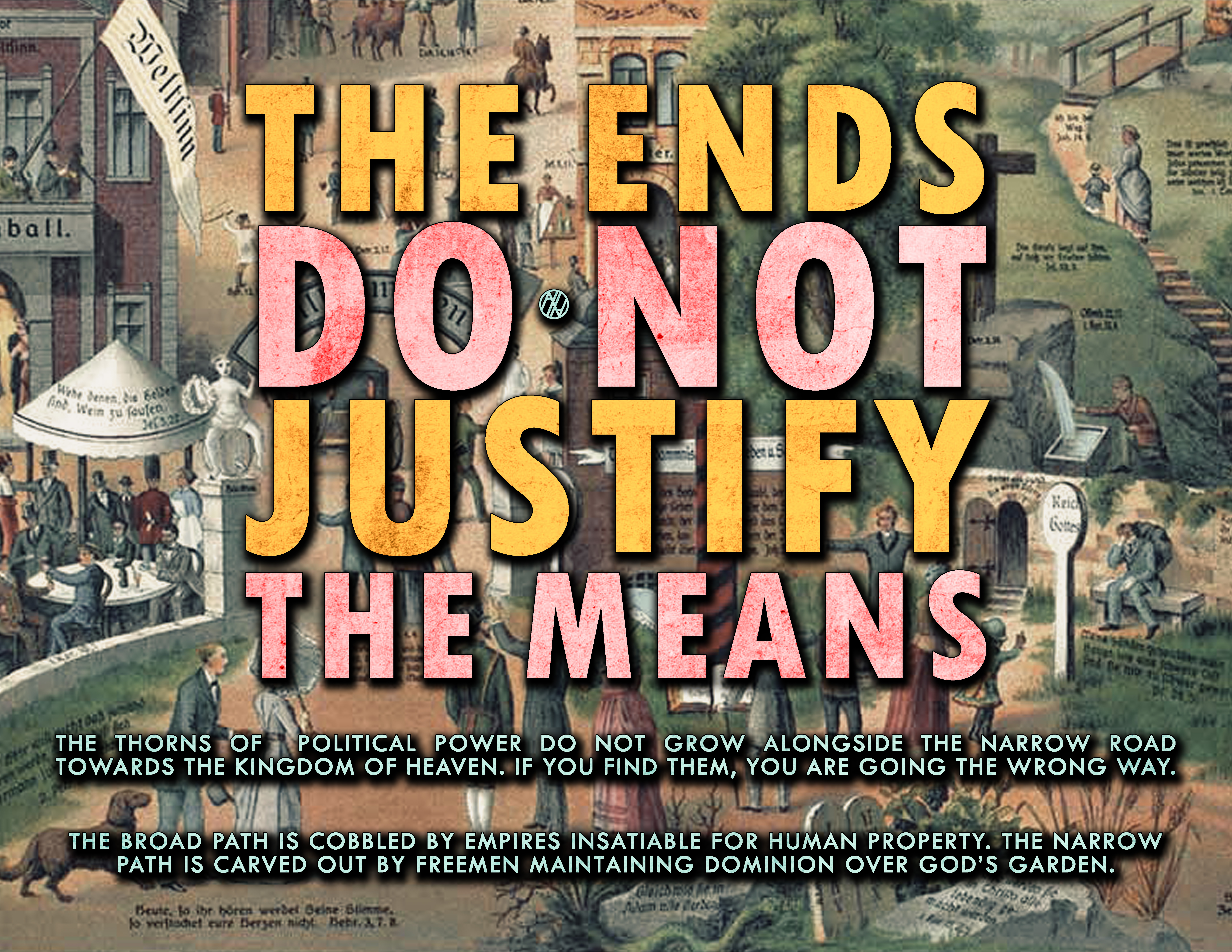
The reason why the path towards the wide gate of destruction is broad and easy to traverse is because it is paved by Empires and cobbled by institutions in order to lure unwitting souls into the subject citizenship of their civil slavery. The yellow-brick road promises that all of your wishes will come true regarding provision, protection, education, prosperity, and military might, but does so at the expense of your neighbor’s taxes, and your own in reciprocation.
The yellow paint is effective at covering up the fact that the brick is initially red: stained with the blood of your children who are collateral for the Empire’s socialist religion, after they had been sold into bondage on the altars of Molech and Baal, through birth registration and social security enrollment. The broad path is a highway. The very reason why all roads lead to Rome is because Rome built them in order to quickly administer oppression across the Empire. The road must be available to disseminate chariots and horses to “civilize” a free world with streamlined, cookie-cutter means of access and egress.
The reason why the path towards the narrow gate of life is constricted and difficult to navigate is because it is carefully and naturally cut by freemen whose consistent labor and necessary, habitual paths blaze a trail towards liberty. The conditions are difficult, the footing must be sure, the journey requires perseverance, and its passengers must be intentional, focused and disciplined. It is not a leisurely venture. It is a dangerous, nimble, and dexterous undertaking, not for the feint of heart. The roads of a free society are not paved with good intentions, they are beat into the terrain by determination, patience, and hard-learned skill, worn into the earth by every individual that traverses them.
What follows will be an undertaking in making straight the way of salvation for those who seek first the Kingdom of God and His righteousness. Really, it is a revelation concerning the progression from repentance to sanctification and then sanctification to redemption, on a societal level. Like all endeavors about expressing doctrinal meat, we should begin with a parable.
The Parable of the Steel Ball
Imagine a a setting characterized by the ideal 1950s American suburbia. Large trees lining either side of a quiet neighborhood street. A sunny Spring morning. A gentle breeze ebbing and flowing through the scenery. Teenagers on bicycles passing by a milk man making his rounds. White picket fences separating well-manicured lawns from familiar sidewalks. A mother hanging freshly washed laundry, still dripping, onto a clothesline. Her young son and his friends loudly entertaining themselves with a game of jacks in the corner of the yard, incurably preoccupied. The boys take their turns, growing more competitively excited after each round. The mother brings out an immaculate white sheet, absolutely soaked and heavy from the wash, displays it tautly on the line and heads back inside.
As her son takes his turn in the game, he glances over at the sheet wafting in the breeze. He is suddenly startled to glimpse a hideous, horned monster on the other side of the sheet. It disappears as the sheet swings back towards him to obstruct his view. He shakes off the vision as a figment of his imagination, and returns his focus to the game. His mind is playing tricks on him. That is, until his turn comes around again, and the breeze moves that sheet just enough for him to notice that ugly, upright beast again. The kid is terrified, but still not entirely sure that he saw anything. Did it really have cloven hooves for feet? Did it really have a long, red tail? Did he really witness a bitter, wicked smile? His friends beckon him to take his turn so they can keep playing. He shakes it off again, bounces the ball, and scoops up some jacks. But his game is slipping.
He barely makes it to the next round when the breeze blows, the sheet moves, the demon is again inexplicably revealed, and the boy is determined to make a decision. His sense of urgency draws him from the game, to the annoyance of his friends who decide to continue without him. Alone in the moment, and without direction, the boy frantically looks around for something, anything, to give him security. Over by the fence, under the bushes, a reflective surface gets his attention. He slowly makes his way in that direction, one eye on the sheet, sweating in fear. He bends down and dislodges the item from its cradle. It’s not very big, though the fingers of one of his hands cannot wrap all the way around it, but it’s got some weight to it. It’s a steel ball. From where? He doesn’t know. But it will have to do.
He walks over to the middle of the yard, squaring up with the sheet; a duel at high noon like in the cowboy shows he watches before supper. The steel ball is in hand, weighing his arm down towards the lawn. With all of his strength, he strains his arm backwards, past his head and pitches that massive ball bearing as hard as he can, aiming right at the middle of that soaking wet sheet. The ball makes contact with enough force to rip that sheet from its clothespins, sending it like a trailing comet through the air before it makes impact across the yard, dragging it through the dirt. There is no demon to be seen.
But there is a very angry mother storming out of the house, berating her son with a scolding that he earned so senselessly. The sheet is ruined and unrecognizable. That steel ball had taken it on a journey of needless insanity. Boys will be boys. She sends him inside to wait for his father to get home, as she starts to undo the mess he made. She walks over to the sheet and begins to pick it up off of the lawn and out of the mud. When she does, and the steel ball rolls away, she sees, to her surprise, there under the sheet, a dead snake.
Neat Story. What’s it mean?
The allegory is one of social change, self-sacrifice, and tragic duty. Our culture, a brilliant, whitewashed, elegant sheet is hiding something sinister and Satanic. The banality of Empire, resplendent with un-encroachable institutions, praised by nationalism, epithets, and civic duties is actually masking predatory forces set on doing evil. Most people in that society distract themselves with childish things. Some wake up to see parts of the horrible reality. Fewer still develop the resolve to do something, anything, about it. And even fewer are able to do something effective about it. It is not just “all in the wrist.” The steel ball of Abolitionism, miraculously bestowed by God’s Providence, in anybody’s sling, can bring down Goliath and crush the serpent’s head.
However, those who wield it, and disrupt the nice game of jacks, to ruin the status quo of society hanging on the line, will be hated by that society with a punishing, exacting, and vengeful force. The truth sounds like hate to those who hate truth. No good deed goes unpunished. The heifer swats at the gadfly even though it is stinging her in the right direction for her own preservation, but against her self-will. The young abolitionist is a necessary scapegoat, crucified for righteousness.
The sheet itself represents a spectrum of condemnation and redemption. The further the steel ball of abolitionist ideology pulls the sheet, the more of the sheet will clear the mud before it makes landfall, and still remains clean on the other side. The force of the ball represents the re-polarization of the moral aptitude of society as it shifts towards righteousness, forcing the point of centrism to move accordingly, finding a new center closer to right thinking. Most of the sheet, however, gets dragged through that mud and experiences most of the jarring, aggressive effects of the changed status quo.
It is not pretty. The facets of society that most closely resemble the truth: many professing christians, homesteaders, more consistent anarchists… will have to reform only a little, as the steel ball shows them the way to repentance and faith unto the Kingdom of God. A more consistent worldview of liberty welcomes the injunction and correction of the necessities to become even more effective at obtaining liberty.
Most of society does not fall into this category. The majority of the sheet is ruined in the mud. The socialists, statists, idolaters, comfortable churchians, political enthusiasts, voters, celebrities, the apathetic, and covetous will have their worlds turned upside down by a wake-up call to repent and seek Heaven’s Kingdom, to the detriment of the kingdoms of the world. Most may not even survive the collapsing of their empire, and will not inherit the alternative Kingdom. They will sink in the mud, as the nice, clean parts of the sheet begin to tear and fray from the parts that remain dirty and defeated. Like sheep being separated from goats. Or wheat from chaff.
The end result of this metaphor is that most will not even recognize that the serpent of statism is only an avatar of a sinister Spirit in perpetual rebellion against God and his rule, who seeks to consume men in a perpetual bondage to a Hellish reality. They will witness the functional necessity of civil reformation, but will still be aloof to the principalities and powers that are exorcised in the process. They will never know just how much danger was poised to destroy them. Only the faithful abolitionist will know, and he will still be sent to bed without supper, as a hero without recognition or thanks, but rather with undue punishment and maybe even martyrdom.
There are no medals for exercising the duty of being against the world, for the world. Your reward is in heaven. We’re here to do a job, and we don’t rattle. Popularity is for suckers anyway. “…Because he’s the hero Gotham deserves, but not the one it needs right now. So we’ll hunt him. Because he can take it. Because he’s not our hero. He’s a silent guardian, a watchful protector. A dark knight.” Blah, blah. blah.
When it is understood how an ideology of Biblical faithfulness used by God’s prophets can shift an entire, unwilling society towards righteousness like a plumbline, a framework can be developed of how that cultural shift might look. Predictions can be made. Steps can be fleshed out. Battle lines can be drawn. What follows is a humble attempt at discerning a seven stage strategy through the fog of our society’s current status quo.
Seeding
All great Christian movements have symbols. Not logos. Not branding. But a representation of their ideology, adopted by everyone faithful to that ideology, in solidarity, expressing their identity in one, harmonious voice. The first century abolitionists recognized each other by the ichthys. The abolitionists of chattel slavery in antebellum America spread their “Am I not a Man and a Brother?” everywhere to solidify their movement in the minds of men as a homogenized, memetic icon. The abolitionists in Nazi Germany heralded the White Rose to signify their opposition to tyranny and resistance to its oppression.
The power of a symbol is in what, and who, it represents. Seeing the symbol tells its witness that there is an agitator in their community. Someone who uses ideological rhetoric to tear down every lofty opinion raised up against the knowledge of God, and his injunctions against sin, subject slavery, and the worldviews that sustain them.
Every abolitionist should be unified in evangelizing their local communities with hard-hitting, uncompromising calls to repentance of sloth, covetousness, and idolatry which lead people to civil bondage. They should be agitating a dying culture to new life, to reflect on their culpability in their oppressive society, and be evangelizing in the highways, byways, on street corners, towards the institutions of their society, and within the marketplaces of goods, services, and ideas.
The first stage in the seven stage strategy of liberty is the soapbox. It is necessary to preach the Gospel of the Kingdom of God to every ear that will hear, to become a spectacle of reformation, disseminating the ideology, rhetoric, and symbol, in order to attract those sheep who hear God’s voice and recognize the truth when confronted by it. Go to the town square. Go to the abortion clinics. Go to the high schools. Go to the churches. Take signs, drop cards, pamphletry, and tracts. Talk to people. Make waves. Do not rely only on social media as a platform for preaching. An actual change in the culture requires a personal, intimate, and confrontational set of tactics. Your neighbor’s house is on fire. Go in there and wake him up. Every community needs a prophet because every community needs to hear the message. The steel ball must be thrown.
The Parable of the Sower comes to mind. The seeds of truth are discarded indiscriminately. Different soils respond differently, but the truth must be preached to them all anyway.
Flowering
When people start to wake up and respond to your calls of repentance, you are then eligible to continue to proliferate the first stage as a group of evangelists. You will meet regularly to discuss tactics, and engagement. You will be of one-mind in the important matters, and start to form a gregarious society, strengthening each other for battle against public opinion. It is necessary to remember that grassroots movements are built on ideologies, and not on organizations. Each member must be beholden to the same tenets and can articulate them in their own conversations with family, friends, and strangers.
The primary task of the Abolitionist Societies will be to gain adherents to the ideology of abolitionism, not just the terminology, and to produce a movement which can consistently make a prophetic call upon society, but mainly towards professing Christians since they at least claim to possess the truth of a Biblical worldview. The abolitionist societies must be a sign to the lost culture across every state, city, town, church, and school. Its purpose is to instruct, to demonstrate, to carry out all of the Christians’ responsibilities everywhere, engaging in both agitation and assistance.
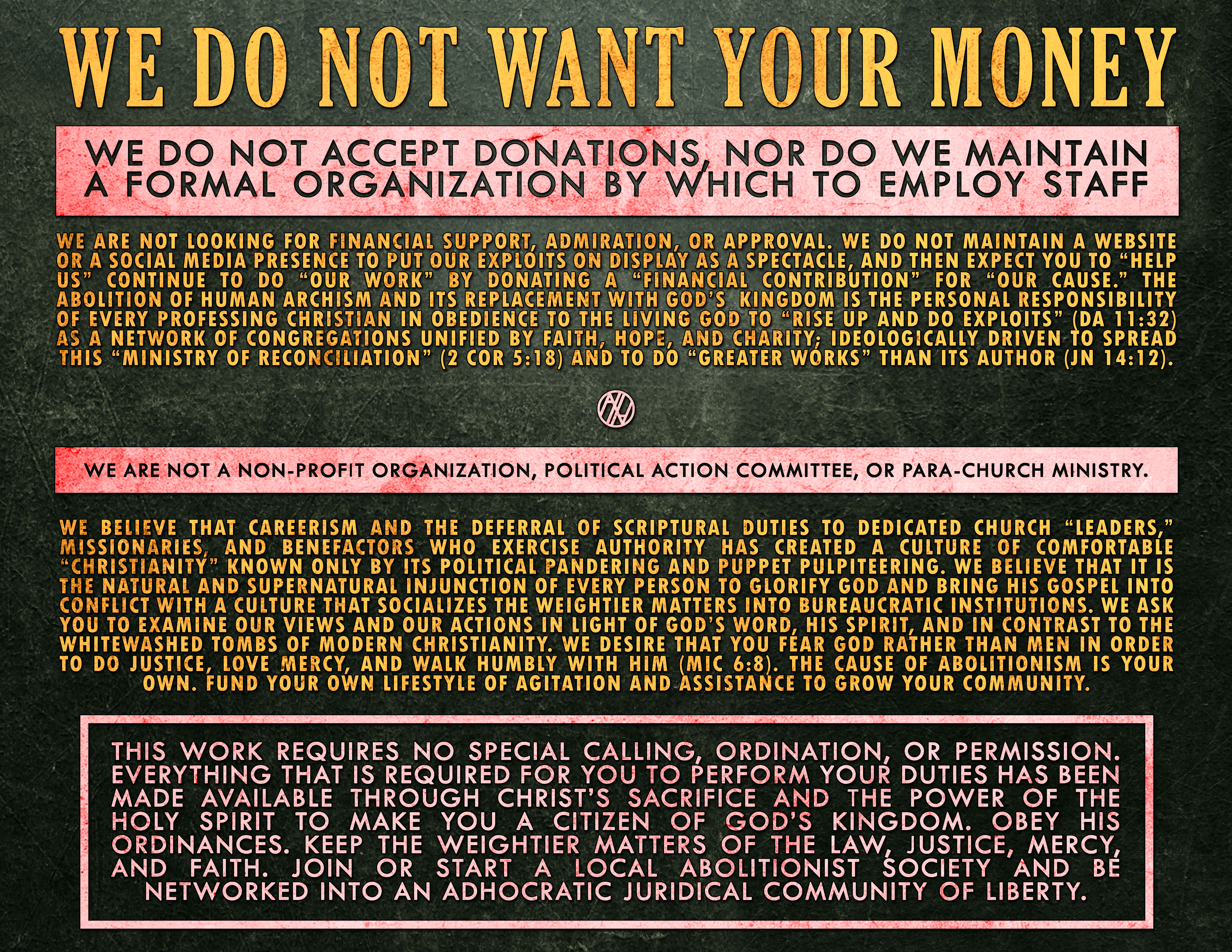
Every single individual must have a personal responsibility to being ideologically driven. Every member must be humble and willing to be built up to love and good works by every other member. There are no “talking heads.” No celebrities. No specialized heroes. No top-down model of authority. No monetary compensation for doing the work that all christians are commanded to do. In a grass-roots movement, every individual is expected to be the leader because every individual is equal. God is not a respecter of persons, and neither are abolitionists. Every weak link in the chain is made strong by every other link. There are no professional abolitionists, because everyone is an expert in abolitionism.
In addition to engaging in public demonstrations as a group, practicing apologetics and moral suasion on the apathetic culture ill-prepared for prophets disrupting their routine lives, the abolitionists in any given society also start to assist each other, bearing each other’s burdens, and sacrificing for one another in the weightier matters: the Law, justice, mercy, and faith. They keep each other free from applying to human civil government for benefits by becoming each other’s welfare through freewill offerings. They work on each other’s houses, teach each other’s children, supplement each other’s finances, and gradually replace the need for authoritarian government in each other’s lives, all through brotherly love. They strengthen the bonds of liberty while also gathering more lost sheep into their relationship.
Weeding
Because grassroots movements are edgy and cool, abolitionist gatherings will be attractive to people of many backgrounds, theological persuasions, and opposing personalities full of presuppositions and philosophical idiosyncrasies. Many of which will require the patience of a “live and let live” attitude.
Some principles, however, will necessitate lines to be drawn. There should be no compromise on the tenets of abolitionist ideology (they are the foundation for calling oneself an abolitionist in the first place), not to mention there needs to be a unanimous assent to some other theological principles that need not be mentioned here. Abolitionism is a purely christian endeavor, not just in orthodoxy but also orthopraxy. Abolitionists must be doers of the word, and not just hearers only. They must be non-violent, they must love their neighbors as themselves, they must hunger and thirst after the righteousness of God, and they must set standards for excellence in behaviors and rhetoric. This means that iron must sharpen iron, men must sharpen each other, and there needs to be a spirit of accountability and humility in order to grow together as a family adopted by God in His Kingdom.
This organic, natural relationship between abolitionists will naturally weed out those who are attracted to the concept of the abolitionist society but would not value the personal holiness necessary to belong to one. It will separate the anarchists from the fanarchists. Because mutual accountability necessitates that every member either be converted to the Christian ideal, or to continuously crawl toward its direction, those who are merely sticking feathers up their butt and calling themselves a chicken will, in their discomfort and conviction, walk away from the movement.
This is not to say that it is okay for abolitionists to chase them away. Rather, those on the fringes of the movement should be reasoned with and persuaded to change their positions or behaviors, from the Scriptures and guidance by the Holy Spirit. Our reputations will precede us across the movement towards every other abolitionist society, so we should act accordingly. We must disciple each other, and not dismiss each other just because that seems easier than winning over an opponent through graceful conversation, seasoned with salt.
To call back to the Parable of the Sower, the truth may begin to take root in some individuals, but their ties to the typical church model or political party may take the truth away from their hearts through sophistry. Modern day “pastors” always promise approval when their church members become anti-abolitionists. No talking head wants to lose the source of their easy income, or the arbitrary authority they hold over their tiny churchian kingdoms. Being against the world for the world often means being against professing christians for professing christians. Deception is everywhere. Self-deception more-so.
Because the weeding of a garden makes more healthy the rest of the garden, and because the refiner’s fire melts away all that is not gold, the purity that remains in an abolitionist society will be better equipped to sustain each other as an embryonic, juridical community: a city on a hill. The sloughing away of dead weight makes for a tighter, more intimate society because it will be difficult for the covetous and the slothful to remain comfortable in taking advantage of your regular charity and goodwill. This paves the way for roles within your society to be defined. Elders will start to be recognized over every household, to represent families to each other. Ministers will start to be called-out from the families to serve them and network those families together, and to network whole abolitionist societies with the ministers of other societies.
This latter role is a necessity because it keeps the movement from turning into an organization. Abolitionist societies aren’t “chapters” answering to a central committee or figurehead. Every family is independent from every other family in the Kingdom of God. They voluntarily come together in adhocratic necessity to agitate the culture and to assist each other as an abolitionist society. This means that every abolitionist society is independent from every other abolitionist society across the world, and they also voluntarily come together to form an adhocratic movement and, more importantly, a kingdom. All of this endeavor is based on personal responsibility, not a central bureaucracy, or micromanaging bylaws. You decide your own level of involvement.
Because societies will be starting to grow at this stage, as well as being tested, and strengthening themselves by exercising the muscles of agitation and assistance, they will start meeting together in nationwide conferences for fellowship. They will start to mobilize like a militia for the truth, descending on each other’s cities to make waves among its people for a short bursts of time. Imagine several groups of abolitionist societies making a pilgrimage to each other’s cities at different intervals, staying for a week or so to partake in brotherly love, but also to agitate that city in coordinated projects and efforts, all of them fulfilling the purpose of Jonah at Nineveh, in a shared voice of remonstrance in favor of the ministry of reconciliation.
They will be passing out tracts, holding signs, wearing the same attire, standing outside of high schools, court houses, military recruitment offices, churches, abortion clinics, IVF facilities, on street corners and in the public square… all in an effort to wake the city from its apathetic slumber while it is in civil bondage owed to its own sin. No iniquitous stone is left unturned. God’s people are here to rise up and do exploits.
These meetings will also serve to strengthen the bonds of brothers and sisters seeking the same Kingdom, belonging to the same heavenly family. They will trade stories and battle scars received in their own cities back home. They will share testimonies. They will celebrate marriages and mourn deaths. They will go into business together and provide opportunities for each other. They will return home, refreshed for the fight in their local communities. God will bless them and they will belong to something greater than themselves.
Repentance
This stage does not refer to those actively seeking to join or start local abolitionist societies, but society as a whole. The truth will start to turn the tide against the lies. Opponents of Abolitionism like Libertarian candidates, or churchian pulpits, will start to repeat abolitionist rhetoric in order to retain their followers, all the while decrying the actions of abolitionists, and never using the symbol of abolitionism though they try to mimic what it stands for. Political and churchian organizations will try to duplicate or replicate the movement in order to capitalize on its success. They will excuse themselves by saying “we agree with your message, but we don’t like they way it’s delivered,” without ever having specific examples. Satan will even attempt to buy out the movement. Whole abolitionist societies may fall away if promised political relevance or churchian acceptance.
The whole culture will be talking about abolitionism like a current event, and its topics of righteousness, statism, liberty, and idolatry, as it starts to repent in spite of itself, being dragged through the mud by the steel ball. This national discussion over watching the world be turned upside down, because abolitionists are exposing false peace covering up deep division, will be intensified by the opposition that abolitionists face. They will start to be persecuted by anti-abolitionists. It will be normalized for those convicted by the truth to assault prophets in public, maybe even to the point of martyrdom. Nationalists, voters, and idolaters will be encouraged to slander, backbite, and defame the agitators who love them enough to try and rouse them from their spiritual death.
Professing Christians will start to divide, en masse, in their own churches. Many will accept the truth of abolitionist ideology and start seeking the Kingdom of God by joining a local society. Most will continue in their pietistic and empty superstitions, rejecting vital Christianity altogether, dissenting from repentance.
Revival
The rhetoric will take root all over the churches. Their members will start to see the supernatural prosperity enjoyed by the Abolitionists and will take the necessary steps to receive it as well. Christians will start waking up to the Kingdom of God, and Christianity will start to be seen, not as a top-down system of “religious service providers” but as the first century practice of pure and undefiled religion. Just like thousands of Jews accepted Jesus as Lord at Pentecost, Christians will stop taking their Lord’s name in vain. They will cease violating God’s commands. They will start visiting the orphan and the widow through networks of charity. They will start walking humbly with God. They may still not call themselves abolitionists or belong to abolitionist congregations, but they will have learned to repent in spite of themselves, to become salty and bright. They will be on the shifting spectrum of righteousness and public opinion, having cleared the mud, enveloping the steel ball.
This is why professing Christians are the target audience for the message of abolitionism. They are more guilty than any other facet of society. They profess to possess the truth, the worldview that demands truth, and the Book that prescribes truth. But in their hypocrisy, they do not act out the truth, and do not work out their salvation in fear and trembling. As go the churches, so goes the culture, unfortunately. But churches will wake up, and while they may not repent of being churches right away, they will start to return to their first love and “do unto the least of these” what they should be doing unto Jesus Christ.
The abolitionist societies will be growing more and more independent from their socialist bondage. Their members will be producing a new generation of little abolitionists, without having applied for birth certification, and social security enrollment. Their salty and bright network will have grown enough to mostly sustain them. They will be pooling their resources to purchase land to donate to individual families, strengthening each other’s hand by teaching them to grow food, raise livestock, and be self-sufficient according to the Dominion Mandate. They will be paying off each other’s debt through charity. God will be multiplying their loaves of bread and fish through the Lord’s supper. God will be providing manna to enrich His Kingdom.
Revolution
Public dissent in favor of liberty will become viable, from abolitionists, but also from “christians,” libertarians, and other “secular-minded” fanarchists. Politicians will be asked what they plan to do about the growing threat of civil disobedience and public outcry against idolatrous institutions.
This will not be like the empty political theater and scripted drama surrounding January 6, Antifa, or Black Lives Matter. This will not be the controlled opposition of some CIA operation (though they will have often tried to infiltrate the movement, thwarted by God’s protection and mutual accountability). This will be the groundwork for economic and political warfare. Nonviolent, but effective. Human civil governments will be familiarized with the phrase “Let my people go.” The notion of boycotting companies that receive taxpayer subsidies will become efficacious. People will start protesting the Blackrock conglomerate. They will start to ignore the economic manipulations of Wall Street.
Human civil government will start to recognize the validity of another Kingdom growing within its jurisdiction. It will start to institutionalize persecution against God’s ministers and Elders, trying to stamp out God’s Kingdom through intimidation. It will imprison abolitionists and create martyrs, thereby sealing its own fate of destruction. Martyrdom only makes the growth of grassroots movements explode, exponentially.
Abolition
Only God knows what this will look like. Though history does repeat. Will we receive a mass Exodus like the Israelites? They were all kicked out of Egyptian citizenship at once, to go and practice their social experiment in the wilderness, still under Egypt’s occupation, before eventually entering into the Promised Land. They had already learned to glean the fields at night to provide for each other a system of charity, while also paying Pharaoh his tale of bricks as a form of income tax.
Will we experience the same fate as the Christians at Pentecost? Thousands of former Jews were kicked out of the social security administrations of Herod and Caesar because they declared themselves to have no King but Jesus. While most had already been instructed by Jesus to sit down in independent communities to feed each other out of charity, their eventual liberation did not afford them a wilderness to enter into. Rather, they stayed in the world (without being of the world) in order to continue to preach repentance and salvation to the lost souls of the Roman Empire.
Many who repented after Pentecost still had their civil burdens of subject citizenship, and did not receive all of their liberty immediately. But they were sustained by free Christians and they all navigated each other’s burdens as needed. They continued doing what they were commanded to do in pure and undefiled religion, indefinitely, until the Roman Empire collapsed in moral and fiscal bankruptcy, imploding under the weight of its own socialism.
Whatever specific scenario the future holds to bring about the Abolition of Human Archism, it will not matter. In any and every case, an alternative, self-sufficient Kingdom will be there to receive those who have sought it. The duty is ours. The results belong to God. The road to liberty is narrow, long and winding. It will not be easy. This is a good deterrent against those who would not be faithful to the necessities of the Kingdom of God anyway. All the same, it is past time to start walking down that road to new life. The time for justice is always now. Repent, for the Kingdom of God is at hand.
 Abolish Human Archism